
How to Choose and Perform Effective Glute Exercises: A Practical Guide
Estimated Reading Time: 6 minutes
Key Takeaways
- Comprehensive Development: Balanced glute training requires pairing compound hip-extension movements (such as squats, hip thrusts, and step-ups) with targeted hip-abduction work (such as side-lying raises and banded walks).
- EMG vs. Long-Term Growth: High electromyographic (EMG) muscle activation indicates momentary neural recruitment during testing, but does not solely guarantee superior long-term strength or hypertrophy.
- Individual Anatomy & Mechanics: Exercise execution, stance width, and movement depth must be tailored to your hip anatomy and pelvic control rather than forcing an arbitrary range of motion.
- Structured Progression: Gradual overload, controlled lowering phases (eccentrics), and avoiding lumbar hyperextension are far more critical than simply chasing a metabolic “burn.”
Table of Contents
- The Anatomy: More Than Just One Muscle
- What the Research Says About Muscle Activation
- Core Hip-Extension Exercises (Targeting the Gluteus Maximus)
- Hip-Abduction Exercises (Targeting the Gluteus Medius and Minimus)
- Programming Your Routine: Sets, Reps, and Recovery
- Common Mistakes to Avoid
- Technique and Safety Considerations
- Next Steps
- Frequently Asked Questions
Building stronger glutes comes down to matching specific movements to how the hips actually work. If you want to strengthen or develop the gluteal muscles, doing endless repetitions of a single exercise rarely produces balanced results. The most effective approach combines compound, loaded hip-extension movements—such as hip thrusts, squats, step-ups, and lunges—with targeted hip-abduction work like side-lying leg raises or banded walks.
Selecting the right exercises depends heavily on your current strength, the equipment you have available, and how well you can stabilize your pelvis without irritating your lower back. By understanding the mechanical roles of the gluteal muscles and what sports science reveals about muscle activation, you can put together a focused, sustainable training plan.
The Anatomy: More Than Just One Muscle
Before choosing movements, it helps to understand what you are training. The glutes are not a single mass of tissue; they are a group of distinct muscles that handle different tasks at the hip joint:
- Gluteus Maximus: The largest muscle in the hips and one of the most powerful in the human body. Its primary role is hip extension—pushing the thigh behind your pelvis, driving you out from the bottom of a squat, or lifting your hips in a bridge. It also assists in lateral (external) rotation of the thigh.
- Gluteus Medius: Situated along the upper outside of the hip, beneath the edge of the maximus. Its main job is hip abduction (moving the leg out to the side away from the body) and stabilizing the pelvis during single-leg actions like walking, running, and climbing stairs.
- Gluteus Minimus: A smaller, deeper muscle lying directly underneath the gluteus medius. It works alongside the medius to abduct the hip and keep the pelvis level when the opposite foot leaves the floor.
Because these muscles perform different biomechanical functions, relying solely on squats or exclusively on light resistance-band circuits will neglect key responsibilities of the hip complex. A well-rounded routine requires training both extension and abduction.
What the Research Says About Muscle Activation
When people search for the “best” glute exercises, they often encounter rankings based on electromyography (EMG). EMG measures the electrical activity generated by muscle fibers when they contract.
In a comprehensive systematic review published in the Journal of Sports Science and Medicine, researchers evaluated dozens of studies to see which movements produced the highest levels of gluteus maximus excitation. The full review findings revealed that loaded step-up variations, hip thrusts, deadlifts, lunges, and squats all produced substantial gluteus maximus activation. Step-up variations frequently generated some of the highest peak EMG values recorded across the literature.
However, an important scientific distinction must be made: high acute EMG activity does not automatically equal superior long-term muscle growth or real-world strength. EMG measures momentary neural recruitment during an isolated repetition. It does not measure mechanical tension across a full range of motion over time, tissue fatigue, or metabolic stress. An exercise that registers an intense contraction in a laboratory test may not automatically be the single best choice for everyone’s long-term training.
Similarly, bodyweight exercises can produce varied levels of recruitment. A systematic review in the Physical Therapy in Sport journal found that bodyweight hip-extension exercises produce a wide range of gluteus maximus EMG activity depending on the specific posture, leverage, and participant experience. Bodyweight movements can be useful starting points or conditioning tools, but their stimulus depends heavily on how the exercise is set up.
When looking at the gluteus medius, an earlier systematic review examined hip-abduction exercises and found that side-lying hip abduction, resisted standing abduction, and side-bridge variations routinely generated the highest gluteus medius activation. If your goal is hip stability or training the upper lateral glute, incorporating dedicated abduction patterns is backed by consistent biomechanical data.
Core Hip-Extension Exercises (Targeting the Gluteus Maximus)
Rather than trying to squeeze every movement into a single workout, select one or two primary hip-extension patterns per session. Focus on executing them with deliberate control through a full, pain-free range of motion.
1. The Glute Bridge and Hip Thrust
The glute bridge (done from the floor) and the hip thrust (done with the upper back elevated on a sturdy bench or box) isolate hip extension while placing minimal shearing stress on the lumbar spine.
- Setup: Sit on the floor with your upper back resting against a stable flat bench (just below your shoulder blades). Place your feet flat on the floor, roughly shoulder-width apart, with your shins roughly vertical at the top of the movement.
- Execution: Drive through your feet to extend your hips upward. Squeeze your glutes at the top until your torso and thighs form a straight line.
- Technique Tip: Avoid arching your lower back at the top. Keep your ribs pulled down and tuck your chin slightly forward so the extension occurs purely at the hip joint rather than through the lumbar spine.
- Progression: Start with a bodyweight glute bridge on the floor. Once you can comfortably perform 15–20 controlled repetitions, elevate your shoulders onto a bench for the hip thrust. From there, place a dumbbell or barbell across your hips (using a pad for comfort). If you train without weights, transition to a single-leg hip bridge to double the relative challenge.
2. The Step-Up
Step-ups consistently generate high gluteus maximus activation because they require deep unilateral hip extension combined with stability demands.
- Setup: Stand facing a sturdy box, bench, or platform. Place your entire working foot on top of the surface so that your heel is fully supported.
- Execution: Shift your weight onto the front leg and lean your torso slightly forward from the hips. Drive down through the front foot to lift your body onto the platform. Lower yourself back down slowly under control over two to three seconds.
- Technique Tip: A common mistake is pushing off aggressively with the toes of the back trailing foot. To make the working glute do the job, minimize the push-off from the floor; treat the back leg as a passive landing gear.
- Progression: Begin on a low step (around 6 to 8 inches) using only body weight, or hold onto a wall for balance. As your balance and single-leg strength improve, gradually raise the step height to roughly knee level, or hold light dumbbells at your sides.
3. The Squat
The squat is a foundational compound exercise that trains the gluteus maximus alongside the quadriceps and adductors.
- Setup: Stand with feet between hip- and shoulder-width apart, with toes angled slightly outward to accommodate your hip anatomy.
- Execution: Initiate the descent by bending your hips and knees simultaneously. Lower yourself until your thighs are roughly parallel to the floor, or as deep as you can comfortably go while keeping your feet flat and your spine neutral. Drive through the midfoot and heel to return to the standing position.
- Technique Tip: Stance width is individual. Some people feel more glute recruitment and hip comfort with a slightly wider stance, while others prefer a narrower track. Adjust your foot position to find a groove that avoids pinching at the front of the hips.
- Progression: Start with an unweighted bodyweight squat or a counterbalanced goblet squat holding a light weight in front of your chest. Only add significant external load once your depth and balance are consistent on every repetition.
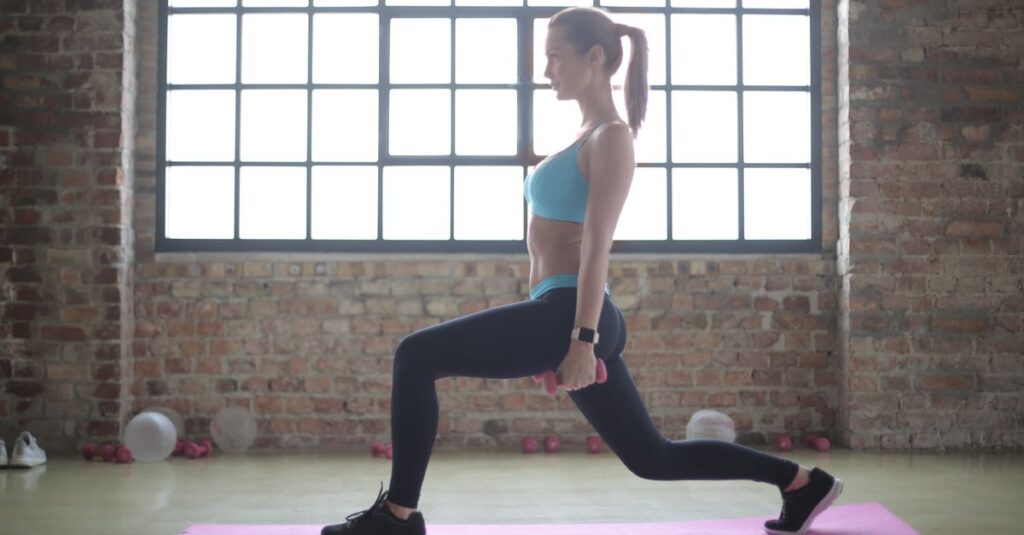
4. The Reverse Lunge or Split Squat
Unilateral leg work allows you to address strength imbalances between sides while placing less compressive load on the spine than heavy bilateral squats.
- Setup: Stand tall. Take a moderate step backward with one leg.
- Execution: Lower your back knee toward the floor until it gently hovers an inch or two above the ground. Your front shin should stay relatively upright or tilt slightly forward, while your torso can tilt forward slightly at the hips to place more mechanical tension on the front glute. Push through the front heel to return to the starting position.
- Technique Tip: If you struggle with balance, perform a static split squat (keeping both feet stationary throughout the set) rather than stepping back and forth on every repetition. You can also hold a wall or a stable railing with one hand.
- Progression: Move from bodyweight split squats to stepping reverse lunges, then add dumbbells held at your sides.
5. The Hip Hinge (Deadlift Variations)
The hip hinge focuses on moving the pelvis backward and forward rather than bending the knees deeply. This creates high levels of tension in the gluteus maximus and hamstrings.
- Setup: Stand with your feet hip-width apart, holding a light weight or using body weight to practice the pattern.
- Execution: With a soft bend in your knees, push your hips straight back toward the wall behind you while maintaining a flat, neutral spine. Keep the weight close to your shins or thighs. Stop when your hips stop moving backward—usually when your torso reaches a roughly 45-degree angle to the floor. Drive your hips forward to return to standing, locking out by contracting your glutes.
- Technique Tip: Do not treat a hinge like a squat. The knees should remain soft but relatively fixed in position; the movement happens via the pelvis swinging back like a pendulum.
Hip-Abduction Exercises (Targeting the Gluteus Medius and Minimus)
Hip-abduction exercises are essential for pelvic stability, gait mechanics, and knee tracking. They also round out the physical development of the lateral hips.
| Exercise | Primary Muscle | Setup & Mechanics | Key Precaution |
|---|---|---|---|
| Side-Lying Hip Abduction | Gluteus Medius & Minimus | Lie on your side with hips stacked vertically. Keep the top leg straight and slightly behind the line of your torso. Raise the leg toward the ceiling leading with your heel. | Do not rotate your hip outward so your toes point upward; this shifts work onto the hip flexors. |
| Side Bridge / Side Plank | Gluteus Medius & Core Abdominals | Lie on your side supported on your forearm and the edge of your feet (or knees for an easier version). Raise your hips until your body forms a straight line. | Keep your chest open and shoulders stacked; avoid sagging toward the floor. |
| Banded Lateral Walk | Gluteus Medius & Maximus | Place a light loop band around your ankles or just above your knees. Assume a quarter-squat stance and take controlled, deliberate side steps. | Maintain continuous tension on the band. Avoid dragging your feet or letting your knees collapse inward. |
When performing abduction work, focus on steady, controlled tempos. Using momentum by swinging the leg or twisting the spine bypasses the target muscles and can cause lower-back discomfort.
Programming Your Routine: Sets, Reps, and Recovery
A common training error is performing dozens of random exercises found on social media without a structured progression. To see steady improvements in strength and tissue development, you need an appropriate training dose.
According to updated resistance training recommendations from the American College of Sports Medicine (ACSM), a broad hypertrophy target is approximately 10 weekly sets per muscle group. For pure strength development, the guidelines highlight using heavier resistances (around 80% of one-repetition maximum) for 2 to 3 sets per exercise.
These ACSM figures represent general programming frameworks rather than a glute-specific mandate. Beginners often make excellent progress on substantially less volume—starting with as few as 4 to 6 total weekly sets of glute-focused work can yield noticeable improvements in strength and coordination.
Here is how you might structure this within a weekly schedule:
- Frequency: Train your glutes 2 to 3 times per week, allowing at least 48 hours between strenuous sessions for recovery.
- Exercise Selection: Pick 2 movements per session:
- Session A: A bilateral loaded extension (e.g., Hip Thrust: 3 sets) + a lateral abduction drill (e.g., Side-Lying Abduction: 2–3 sets).
- Session B: A unilateral extension (e.g., Step-Ups or Reverse Lunges: 3 sets) + a hinge variation (e.g., Romanian Deadlift: 2–3 sets).
- Reps and Load: Work with a weight or variation that challenges you within 8 to 15 controlled repetitions, leaving 1 to 2 reps “in reserve” before absolute technical failure. Avoid lifting to a point where your form breaks down.
- Progression: When a set becomes easy to complete with perfect technique, progress slowly. Add 1–2 repetitions, slow down the eccentric (lowering) phase to three seconds, or increase the weight slightly.
Common Mistakes to Avoid
- Chasing the “Burn” Instead of Progressive Overload: A burning sensation often just reflects local metabolic waste products from high-repetition, short-rest movements. While not harmful, feeling a burn does not mean an exercise is building long-term strength better than a properly loaded compound movement.
- Hyperextending the Lumbar Spine: In movements like the glute bridge, hip thrust, or deadlift, trainees often try to force extra range of motion at the top by arching their lower back. True hip extension ends when the thigh and torso form a straight line. Squeeze the glutes, keep your ribcage down, and do not arch your lower spine.
- Increasing Resistance Too Quickly: Moving to heavy weights or high boxes before developing single-leg stability can lead to compensations, such as letting the knee cave inward (valgus collapse) or rocking the upper body to create momentum. Build stability on a lower box or with lighter resistance first.
- Neglecting the Lowering Phase: Dropping quickly out of a squat or letting your body plummet from a step-up discards the eccentric portion of the lift, which is a major driver of strength and muscle adaptation. Lower yourself under control on every repetition.
Technique and Safety Considerations
Educational Note: The exercises and programming ideas described here are for general physical conditioning. If you have a history of hip impingement, lower-back pathology, joint pain, or pelvic injury, consult a physical therapist or qualified sports clinician before starting or altering a resistance-training routine.
- Listen to Joint Signals: Muscle fatigue feels like deep effort and warmth within the muscle belly. Sharp, catching, or radiating pain around the hip socket, groin, or lower back indicates that the movement, load, or range of motion needs immediate modification.
- Adjust Depth to Your Structure: Hip socket anatomy varies widely from person to person. Never force a squat or lunge depth that causes pinching in the front of your hip joint or forces your spine into a sharp curve. Work through a range of motion that you can stabilize actively.
- Stabilize Your Base: When performing lunges or step-ups, ensure your foot remains planted firmly across the tripod of your heel, the base of your big toe, and the base of your little toe. A steady foot creates a steady hip.
Next Steps
To begin building your routine, you do not need an elaborate setup or a long list of exercises. Start by choosing one loaded hip-extension exercise (such as the glute bridge or goblet squat) and one hip-abduction exercise (such as the side-lying leg raise).
Perform 2 to 3 sets of each movement, twice a week, focusing entirely on controlled execution, a neutral spine, and feeling the hips perform the mechanical work. Track your repetitions and weights, and only add resistance when you can complete every rep with steady balance and precision.
Frequently Asked Questions
According to systematic review findings, loaded step-up variations, hip thrusts, deadlifts, lunges, and squats all produced substantial gluteus maximus activation, with step-up variations frequently generating some of the highest peak EMG values recorded across the literature.
The glutes are not a single muscle; they comprise the gluteus maximus, gluteus medius, and gluteus minimus. Relying solely on squats focuses primarily on hip extension while neglecting the hip abduction and pelvic stabilization responsibilities handled by the gluteus medius and minimus.
No. A burning sensation often reflects local metabolic waste products from high-repetition, short-rest training. While not harmful, feeling a burn does not indicate that an exercise builds long-term strength or tissue adaptations better than a properly loaded compound movement executed through progressive overload.
General resistance training recommendations from the ACSM outline a broad hypertrophy target of approximately 10 weekly sets per muscle group. However, beginners can make noticeable improvements in strength and coordination starting with as few as 4 to 6 total weekly sets.