
Kettlebell Workouts: A Practical Guide to Exercises, Form, and Programming
Estimated Reading Time: 8 minutes
Key Takeaways
- Evidence-Based Strength: Kettlebells effectively develop explosive hip extension and functional strength, but they do not replace dedicated aerobic cardiovascular conditioning.
- Dual-Weight Approach: Beginners should avoid the “universal weight” myth and select two loads: a lighter bell (8–12 kg) for upper-body work and a moderate-to-heavy bell (12–16 kg) for lower-body compound movements.
- Controlled Foundation First: Slow, controlled grinds (goblet squats, deadlifts, rows, floor presses, and carries) must be mastered with strict form before attempting dynamic, ballistic swings.
- Joint Safety & Progression: Technical consistency and spinal neutrality always precede load increases; ballistic exercises require a solid, unweighted hip hinge baseline.
Table of Contents
- What the Research Actually Says About Kettlebell Training
- Selecting Your Starting Weights
- Five Foundational Controlled Exercises
- When to Swing: Addressing Ballistic Moves
- A Structured Beginner Routine
- Safety Guidelines and Clinical Considerations
- Next Steps for Your Training
- Frequently Asked Questions
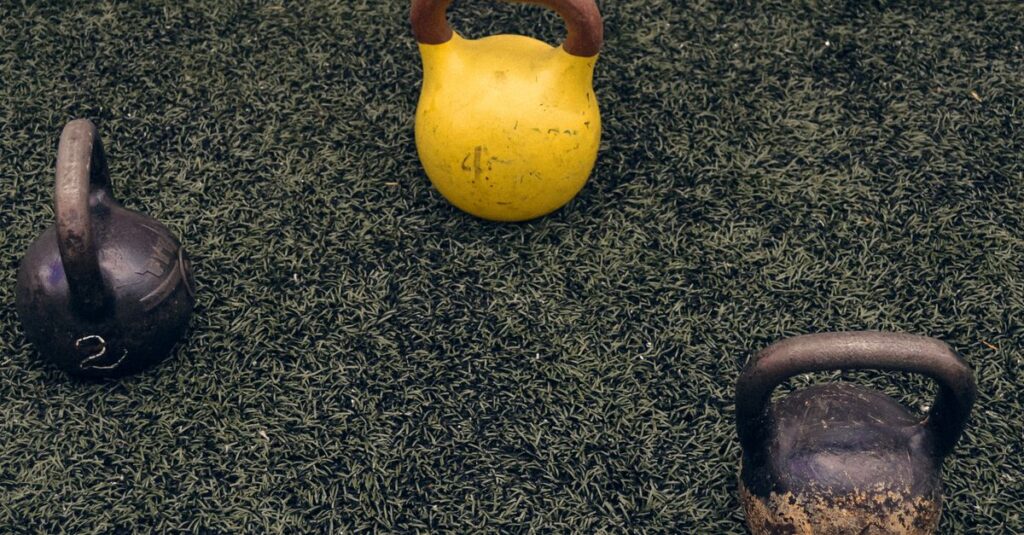
Starting a kettlebell routine often feels unnecessarily complicated. You pick up a cast-iron weight with an off-center handle, and the immediate questions follow: Which weight is safe? Should you swing it right away? How many sets and repetitions actually build strength without causing a back strain?
Effective kettlebell workouts do not require complex juggling or exhausting high-speed circuits. For most people, the kettlebell is simply a versatile tool for resistance training. It allows you to train fundamental human movement patterns—squatting, hinging, pushing, pulling, and carrying—in very little space. However, because the weight hangs below a thick handle rather than resting evenly across your palms like a dumbbell, it challenges your grip, balance, and shoulder stabilizers differently.
Before adding ballistic, high-speed movements like snatches or swings to your week, you need to understand what the research says, how to select your starting weights, and how to execute the essential controlled movements with solid mechanics.
What the Research Actually Says About Kettlebell Training
Marketing claims frequently position the kettlebell as an all-in-one fitness miracle that burns twice the calories of traditional lifting, builds elite cardiovascular endurance, and fixes bad posture overnight. The scientific literature paints a more measured picture.
A systematic review published in Physical Therapy Reviews evaluated the available evidence on kettlebell training and found moderate support for improvements in specific measures of muscular strength and power in healthy adults. However, the same review found no evidence that kettlebells improved aerobic capacity as measured by VO2 max. The authors also noted that the overall evidence base is limited: only five studies met the criteria for inclusion, which restricts how broadly these findings can be applied across different age groups and fitness backgrounds.
Similarly, a clinical practice review in The Physician and Sportsmedicine pointed out that formal, evidence-based exercise prescription guidelines for kettlebells do not exist in primary care. Most intervention studies completed to date have been small, underpowered, and of low-to-moderate methodological quality.
What does this mean for your training?
- Strength and power gains are real: Kettlebells provide effective external resistance. When programmed systematically, they can develop explosive hip extension and whole-body muscular strength.
- They do not replace dedicated conditioning: If your primary goal is maximizing cardiovascular endurance (VO2 max), relying solely on kettlebells will likely fall short compared to traditional endurance or dedicated cardiovascular training.
- They are not inherently superior to dumbbells or barbells: Resistance is resistance. The kettlebell is an effective implement, but it does not possess special metabolic properties that automatically burn more fat or prevent injuries better than other training tools.
Selecting Your Starting Weights
One of the most frequent mistakes beginners make is buying a single kettlebell and trying to use it for every drill. A weight that challenges your legs during a deadlift will be far too heavy for an overhead press, while a bell light enough for pressing will barely register during a two-handed squat.
According to Harvard Health Publishing, lifting too much weight too soon or using improper mechanics can quickly lead to muscle strains, rotator cuff injuries, or accidental drops. They recommend choosing a conservative load that allows you to complete every repetition with total control, ideally learning the basics under the eye of a qualified coach.
Guidance from the Cleveland Clinic also emphasizes mastering movement mechanics before adding external load, gradually stepping up the resistance only when your form remains unchanged from the first rep to the last.
Instead of hunting for an elusive “universal” weight, aim for two distinct loads if you are stocking a home gym:
- A lighter bell: Used for upper-body pressing, single-arm rows, and learning rotational or overhead balance. For an untrained adult, this often falls between 8 kg (18 lbs) and 12 kg (26 lbs).
- A moderate-to-heavy bell: Used for lower-body compound movements like goblet squats, suitcase carries, and deadlifts. For an untrained adult, this often falls between 12 kg (26 lbs) and 16 kg (35 lbs).
If you cannot maintain a neutral spine, if your wrists bend backward under the handle, or if you must use body momentum to complete a slow, grinding lift, the weight is too heavy. Put it down and scale back.
Five Foundational Controlled Exercises
While dynamic, swinging lifts receive the most attention on social media, controlled, slow-speed movements form the safest foundation for kettlebell workouts. Master these five exercises before attempting dynamic, ballistic lifts.
       Goblet Squat (Knee-dominant lower body)
                         │
      Kettlebell Deadlift (Hip-dominant hinge)
                         │
        One-Arm Row (Upper-body pulling)
                         │
        Floor Press (Upper-body pushing)
                         │
       Suitcase Carry (Core stability & grip)
1. The Goblet Squat
The goblet squat places the load in front of your chest, acting as a natural counterbalance that helps you keep your torso upright and your weight balanced across your midfoot.
- How to do it: Stand with your feet slightly wider than shoulder-width apart, toes turned outward 15 to 30 degrees. Hold the kettlebell by its horns (the sides of the handle) directly against your upper chest, keeping your elbows tucked downward. Take a breath, brace your midsection, and descend by pushing your hips back and bending your knees simultaneously. Lower yourself until your thighs are roughly parallel to the floor, pause briefly, then push the ground away through your full foot to return to standing.
- Easier option: Perform a box squat by lowering yourself onto a sturdy chair or bench, pausing without relaxing your core, and standing back up. You can also perform this with bodyweight alone.
- Common mistake: Letting the elbows flare out to the sides or allowing the weight to pull your shoulders forward, rounding your upper back.
2. The Kettlebell Deadlift
The deadlift teaches the “hip hinge”—the foundational movement required for safe bending, lifting, and eventual kettlebell swinging. It targets the glutes, hamstrings, and spinal erectors.
- How to do it: Place the kettlebell on the floor directly between your feet, inline with your ankle bones. Stand with a hip-width stance. Without bending your knees excessively, push your hips straight back toward the wall behind you. Soften your knees only as much as necessary to reach the handle. Keep your chest proud, spine straight, and grasp the handle firmly with both hands. Drive your feet into the floor, squeeze your glutes, and push your hips forward until you are standing tall. Reverse the motion by hinging backward to return the bell to the floor.
- Easier option: Elevate the kettlebell on a sturdy block or step to reduce the range of motion if tight hamstrings cause your lower back to round when reaching the floor.
- Common mistake: Squatting down with knees shifting forward instead of hinging back at the hips. The shins should remain nearly vertical throughout the setup.
3. The One-Arm Kettlebell Row
Upper-body pulling strength balances out chest-heavy pushing and supports shoulder stability. A supported single-arm row allows you to build back strength without straining the lumbar spine.
- How to do it: Place your left hand and left knee on a sturdy flat bench (or place your left hand on a secure table or high box in a staggered stance). Keep your back flat and parallel to the floor. Reach down with your right hand and grasp the kettlebell handle. Without rotating your shoulders or hips, pull the kettlebell upward toward your lower hip, leading with your elbow. Pause for a second at the top, then lower the bell under control until your arm is fully extended.
- Easier option: Use a lighter bell or shorten the range of motion slightly while focusing strictly on the squeeze between your shoulder blades.
- Common mistake: Jerking the torso upward or rotating the chest open toward the ceiling to heave the weight up. The torso must remain quiet and stationary.
4. The Kettlebell Floor Press
The floor press builds pressing strength in the chest, shoulders, and triceps while protecting the front of the shoulder joint, as the floor acts as a hard stop that prevents excessive shoulder extension.
- How to do it: Lie on your back on an exercise mat with your knees bent and feet flat on the floor. Carefully roll to your side to grasp the kettlebell, then roll onto your back, positioning the bell on the outside of your forearm with your elbow resting on the floor at roughly a 45-degree angle from your ribs. Press the kettlebell straight up toward the ceiling until your elbow locks out. Lower the bell slowly until your upper arm touches the floor, pause for a moment to kill the momentum, and press again.
- Easier option: Press with both hands holding a single bell across your chest, or switch to a lighter weight.
- Common mistake: Allowing the wrist to bend backward under the weight of the bell. Keep your wrist completely straight, as if throwing a punch.
5. The Suitcase Carry
Carrying a load on only one side of your body forces your deep abdominal stabilizers, oblique muscles, and hip abductors to work together to keep you upright.
- How to do it: Deadlift a moderate kettlebell off the floor with one hand. Stand tall with your shoulders level and your ribs drawn down. Walk forward slowly in a straight line for 20 to 30 paces. Turn around, switch hands, and walk back.
- Easier option: Walk shorter distances, reduce the weight, or perform a two-handed farmer’s walk with an equal weight in each hand.
- Common mistake: Leaning your torso to the opposite side to balance out the load. Your shoulders and hips should remain level, as if you were walking without any weight at all.
When to Swing: Addressing Ballistic Moves
In their clinical review of kettlebell literature, practitioners identified six fundamental movements commonly used in training: the swing, clean, press, squat, snatch, and Turkish get-up. However, the presence of these exercises in research does not mean they are all appropriate for beginners working without supervision.
The two-handed kettlebell swing is the most famous ballistic lift, but it is frequently practiced incorrectly. It is an explosive hip hinge, not a shoulder raise and not a squat.
A study protocol detailing swing mechanics in BMC Sports Science, Medicine and Rehabilitation outlines the key biomechanical requirements:
- Keep the spine straight throughout the movement.
- Project the hips backward during the descent, keeping the shin angle relatively vertical.
- Drive the movement through powerful hip extension rather than pulling with the arms.
- Finish the upward drive in a tall standing position with hips fully locked out and the abdominal wall braced.
Incorrect (Squatting the swing):
Hips drop low ──> Knees travel forward ──> Arms pull bell upward ──> Lumbar strain

Correct (Hinging the swing):
Hips hinge back ──> Shins stay vertical ──> Glutes snap forward ──> Bell floats from hip power
If you cannot perform 15 clean, unweighted hip hinges with your hands on your hips, or if your lower back rounds during a standard kettlebell deadlift, you are not ready for swings. Ballistic movements multiply the dynamic forces applied to the lumbar spine and shoulders; attempting them before mastering the static hinge introduces unnecessary risk.
Work on your deadlift mechanics first. Once your hinge is crisp, consistent, and automatic, introduce swings at low volumes (such as short sets of five to eight repetitions).
A Structured Beginner Routine
This weekly framework prioritizes balance, recovery, and movement quality. Rather than training to muscular failure, the goal is to practice each movement pattern with technical proficiency.
The Cleveland Clinic suggests using two to three sets of eight to ten repetitions per exercise as an effective starting benchmark, progressively challenging yourself as your control improves.
The Full-Body Starter Template
Perform this session two to three times per week on non-consecutive days (for example, Monday, Wednesday, and Friday).
| Exercise | Movement Pattern | Working Sets | Target Reps | Rest Period |
|---|---|---|---|---|
| Goblet Squat | Squat (Lower Body) | 2–3 | 8–10 reps | 60–90 seconds |
| Kettlebell Deadlift | Hinge (Posterior Chain) | 2–3 | 8–10 reps | 60–90 seconds |
| One-Arm Kettlebell Row | Horizontal Pull | 2–3 | 8–10 reps / side | 60 seconds |
| Kettlebell Floor Press | Horizontal Push | 2–3 | 8–10 reps / side | 60 seconds |
| Suitcase Carry | Anti-Lateral Flexion Carry | 2–3 | 30 steps / side | 60 seconds |
Managing Rest and Progression
You do not need to time your rest periods down to the second. Rest long enough that your breathing returns to normal and you feel mentally focused for the next set—typically between 60 and 90 seconds on compound lifts. Rushing through sets with incomplete recovery compromises spinal stability and degrades technique.
When you can easily complete three sets of ten repetitions across every exercise with pristine form, progress your training using one of the following methods:
- Add a repetition: Increase from 8 reps to 9 or 10 reps per set while using the same bell.
- Add a set: Move from two total working sets to three.
- Increase the load: Move to the next kettlebell size up (typically a 2 kg to 4 kg increase) and drop back down to the lower end of the rep range (e.g., three sets of six to eight reps).
Never change both the weight and the volume at the same time.
Safety Guidelines and Clinical Considerations
Kettlebell workouts place unique rotational and shear stresses on the joints. Training responsibly means respecting those forces and understanding your personal physical limitations.
Surface and Setup
Always train on a flat, nonslip surface. Working on thick pile carpet, slick hardwood floors in socks, or uneven grass increases the risk of slipping or rolling an ankle. Wear flat-soled, non-compressible shoes (like minimalist trainers or flat canvas sneakers) or train barefoot if your environment permits. Shoes with thick, cushioned running heels push your weight forward onto your toes, making it significantly harder to maintain a solid hip hinge.
Pain vs. Fatigue
Muscle fatigue and light burning are normal physical responses to resistance training. Sharp, stabbing, or pinching sensations—especially in the lumbar spine, anterior shoulder, or wrists—are not. If an exercise causes joint pain, stop immediately. Regress the movement, lower the load, or swap the exercise for an alternative pattern.
Medical Precautionary Notes
Certain populations should approach kettlebell training with heightened caution:
- Osteopenia and Osteoporosis: Harvard Health Publishing notes that individuals with reduced bone density should avoid rapid, jerky movements and heavy spinal loading, as excessive rotational or bending forces can increase fracture risk.
- Prior Shoulder or Back Injuries: Because the clinical evidence regarding kettlebell rehabilitation is limited and low in methodological quality, kettlebell routines should not be treated as a self-directed physical therapy program. If you have chronic disc pathology, severe arthritis, or existing rotator cuff tears, consult an orthopedist or physical therapist for an individualized program before lifting kettlebells.
Next Steps for Your Training
If you are ready to begin, do not worry about mastering all six classic kettlebell lifts this week. Keep your initial plan manageable and concrete:
- Clear a space: Find an open area roughly six feet by six feet with a nonslip surface.
- Rehearse the hinge: Before touching the weight, perform ten unweighted hip hinges against a wall. Stand six inches away with your back to the wall and hinge backward until your glutes touch it, keeping your back flat.
- Run through one cycle: Complete a single round of the starter template above using very conservative weights. Note which movements feel intuitive and which feel awkward.
- Build consistency first: Stay with the controlled starter movements for four full weeks. Focus entirely on crisp mechanics, smooth breathing, and repeatable reps before even considering dynamic swings or overhead snatches.
Frequently Asked Questions
Can kettlebell workouts replace traditional cardio for improving aerobic capacity?
According to a systematic review published in Physical Therapy Reviews, there is no evidence that kettlebells improve aerobic capacity as measured by VO2 max. While kettlebells effectively build muscular strength and explosive power, dedicated cardiovascular training remains necessary if your primary goal is maximizing endurance.
What starting kettlebell weight should a beginner purchase?
Instead of buying a single “universal” bell, aim for two loads: a lighter bell between 8 kg (18 lbs) and 12 kg (26 lbs) for upper-body pushing and pulling, and a moderate-to-heavy bell between 12 kg (26 lbs) and 16 kg (35 lbs) for lower-body compound movements like squats and deadlifts.
Should beginners perform kettlebell swings right away?
No. Ballistic exercises like swings multiply dynamic forces on the spine and shoulders. You should first demonstrate 15 clean, unweighted hip hinges and consistent form on standard kettlebell deadlifts before introducing swings at low volumes.
Who should avoid or modify kettlebell training?
Individuals with osteopenia or osteoporosis should avoid rapid, jerky movements and heavy spinal loading due to fracture risk. Additionally, those with chronic disc issues, existing rotator cuff tears, or severe joint pathology should consult a physician or physical therapist prior to starting.