
Pelvic Floor Exercises: How to Do Them Correctly, What the Evidence Shows, and How to Build a Routine
Estimated reading time: 7 minutes
Key Takeaways:
- Pelvic floor muscle training (PFMT) requires both an inward and upward lift and a distinct, complete release to be effective.
- A balanced routine trains slow-twitch fibers for baseline endurance and fast-twitch fibers for reactive power against sudden pressure.
- Clinical evidence confirms that 8 to 12 weeks of consistent daily exercises can significantly cure or improve stress and mixed urinary leakage.
- Avoiding common mistakes like breath-holding, bearing down, or gripping the glutes is essential to prevent straining and counterproductive outcomes.
Table of Contents
If you have ever leaked a small amount of urine when you coughed, sneezed, or jumped, you have probably been told to “just do your Kegels.” Yet most people receive little guidance on what a proper contraction feels like, how often to train, or how to tell if they are doing more harm than good.
Pelvic floor exercises—clinically known as pelvic floor muscle training (PFMT)—consist of deliberate, repeated contractions and full relaxations of the muscles spanning the base of your pelvis. These muscles form a supportive sling underneath the bladder, bowel, and, in women, the uterus.
When performed correctly, PFMT can significantly reduce or resolve urinary leakage. However, technique matters just as much as consistency. Squeezing the wrong muscles or failing to relax can stall your progress entirely.
How to Find and Contract the Pelvic Floor Muscles
The most common mistake people make is clenching the buttocks, gripping the inner thighs, or holding their breath. A true pelvic floor contraction is subtle from the outside; your outer body should remain completely still.
The Mental Cues
According to guidance from North Bristol NHS Trust physiotherapy, the clearest way to locate these muscles is by using two specific internal cues:
- The back passage: Imagine you are trying to stop yourself from passing wind. You should feel a squeeze and a slight inward pull around your anus.
- The front passage: Next, imagine you are sitting on the toilet and trying to stop the flow of urine midstream. You should feel a gentle lifting sensation at the front.
Combine these two actions into one smooth movement: close around the back, close around the front, and draw the muscles upward inside your pelvis.
The Sensations to Aim For (and Avoid)
- What it should feel like: An inward and upward lift. Think of an internal elevator rising away from your underwear.
- What it should not feel like: A downward bearing down. If you feel pressure pushing outward or downward—the same motion you might use during a difficult bowel movement—stop immediately. Bearing down strains the pelvic floor and can worsen symptoms.
- The release is essential: A contraction is only half the exercise. When you let go, you must feel a distinct, complete release of tension. The muscles should drop back to their resting baseline before you attempt another repetition.
A note on safety: Never practice pelvic floor exercises while actually urinating. While stopping your stream is a helpful mental picture to identify the muscles, NHS physiotherapy guidelines advise against doing this on the toilet, as it can disrupt normal bladder emptying.
A Structured Beginner Routine
Pelvic floor muscles contain two types of muscle fibers: slow-twitch fibers that provide ongoing, postural support throughout the day, and fast-twitch fibers that react quickly to sudden increases in abdominal pressure (like a laugh, cough, or stumble). A balanced routine trains both endurance and speed.
The following sample routine is based on clinical frameworks from the North Bristol NHS Trust and recommendations from the National Institute for Health and Care Excellence (NICE).
1. Starting Position
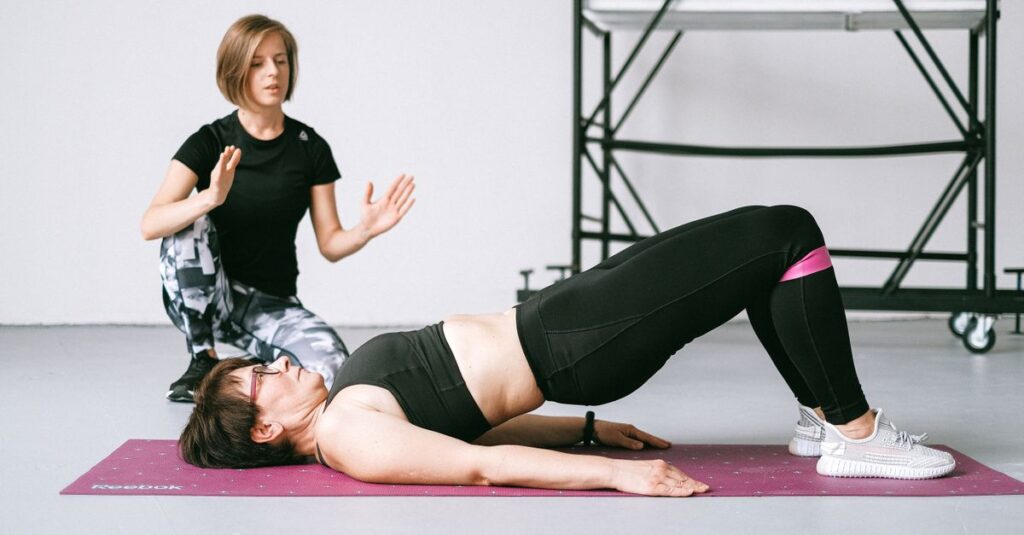
Begin either sitting upright on a firm chair with your feet flat on the floor, or lying on your back with your knees bent and feet resting comfortably. Lying down eliminates the pull of gravity, making it easier to feel the lift and full release if you are just starting out.
2. Slow Contractions (Endurance)
- Breathe in gently, and as you breathe out, tighten and lift your pelvic floor muscles.
- Hold the lift for around 5 seconds. Continue breathing normally throughout the hold; do not hold your breath.
- Fully release the muscles and rest for roughly 5 seconds.
- Repeat this cycle. Aim to build up to a target of 10 slow contractions per session.
- Progression: As your muscular control improves, gradually increase the hold time second by second until you can maintain a steady, comfortable lift for 10 seconds, followed by 10 seconds of rest.
3. Quick Contractions (Power and Speed)
- Draw the muscles upward quickly and firmly, then let go immediately.
- Ensure you feel the full release between each pulse.
- Aim to build up to 10 quick contractions in a row.
4. Daily Frequency
To see functional improvements in stress or mixed incontinence, NICE clinical guidance recommends a programme that includes at least eight contractions performed three times throughout the day.
| Exercise Type | Beginner Target | Progression Goal | Purpose |
|---|---|---|---|
| Slow Contractions | 5-second hold, 5-second rest (build to 8–10 reps) | 10-second hold, 10-second rest (10 reps) | Builds endurance to support organs and maintain baseline continence |
| Quick Contractions | 3–5 rapid squeezes with full release | 10 rapid squeezes with full release | Builds reactive power to prevent leaks during coughs, sneezes, or impact |
| Frequency | 2–3 sessions daily | 3 sessions daily | Stimulates neuromuscular adaptation over a minimum of 3 months |
Prioritize quality over numbers. If your muscles fatigue after four repetitions and you find yourself tensing your jaw, stomach, or thighs to compensate, stop there. Rest and return for your next session later in the day.
What the Research Says About Results
If you are dealing with urinary leakage, pelvic floor muscle training is not simply a lifestyle tip; it is a primary, evidence-backed medical intervention.
The Clinical Evidence
A comprehensive Cochrane systematic review evaluated 31 trials involving 1,817 women to determine how PFMT compares to no treatment or inactive control care. The researchers found moderate-quality evidence that women who undertook PFMT were significantly more likely to report that their symptoms were cured or improved compared to those who received no active intervention.
Because of this evidence, NICE guidelines on urinary incontinence advise clinicians to offer a supervised programme of pelvic floor muscle training for at least three months as the first-line treatment for women presenting with stress urinary incontinence or mixed urinary incontinence.
Furthermore, NICE guidance on pelvic floor dysfunction encourages women—including those who are pregnant or recently gave birth—to practice pelvic floor exercises to help prevent symptoms from emerging, and supports maintaining this training over the long term.
Realistic Expectations
While the data strongly supports PFMT, it is not an instant cure or a universal guarantee:
- Timeframe: Muscle adaptations take time. A meaningful reduction in leakage typically requires consistent daily practice for at least 8 to 12 weeks.
- Variable Studies: The trials analyzed in the Cochrane review used differing training routines and evaluated varied patient populations, meaning individual rates of recovery naturally differ.
- The Role of Proper Function: Squeezing harder will not help if the underlying issue involves an inability to relax the muscles or poor coordination.
Using the Muscles in Daily Life
Isolating your pelvic floor while sitting quietly is the first stage of training. The second stage is using that strength to protect yourself against sudden leakage in real-world scenarios.
The Functional Squeeze
If you tend to leak during specific activities—such as coughing, clearing your throat, sneezing, or lifting a heavy shopping bag—you can brace your pelvis using a functional contraction.
As outlined in NHS physiotherapy guidance, you should gently lift and tighten your pelvic floor just before and during the moment of increased abdominal pressure (such as the split second before a sneeze occurs). This counteracts the sudden downward force on your bladder neck.
Managing Sudden Urgency
If you experience sudden, overwhelming urges to urinate (urgency), rushing to the bathroom can actually increase intra-abdominal pressure and heighten bladder contractions, leading to a leak before you arrive.
Instead, NHS guidance suggests pausing when the urge hits. Stand or sit still, gently tighten your pelvic floor muscles, and hold the contraction until the cramping sensation in your bladder calms down. Once the urge subsides, walk calmly to the toilet.
Common Mistakes That Sabotage Progress
Many people perform pelvic floor exercises diligently for weeks without seeing results simply because an unnoticed mechanical error is neutralizing their efforts.
Common Errors to Watch For:
├── Holding your breath (increases pressure in the chest and abdomen)
├── Clenching the glutes or inner thighs (takes work away from the pelvic floor)
├── Bearing down/straining (pushes pelvic organs downward)
└── Skipping the relaxation phase (leaves muscles fatigued and hypertonic)
- Breath-Holding: When you hold your breath, your diaphragm fixes downward, increasing pressure inside your abdomen. This forces your pelvic floor to fight against your breath rather than lifting cleanly. If you cannot speak or exhale while holding a contraction, you are holding too tightly.
- Co-Contracting Surrounding Muscles: Watch yourself in a mirror or place your hands on your buttocks and outer hips. If your hips move, your butt clenches, or your abdominal wall bears outward, you are recruiting larger prime movers to do the job of your deep pelvic stabilizers.
- Ignoring the Release: Muscles that are constantly held in a state of semi-contraction become tight, short, and weak. If you do not let the pelvic floor fully drop and lengthen between repetitions, you risk developing chronic pelvic tightness, which can ironically cause urinary urgency and pelvic discomfort.
- Stopping Midstream as an Exercise: While it is a helpful test to verify which muscles to use once or twice, regularly cutting off your urine stream can lead to incomplete bladder emptying and abnormal urinary mechanics.
When Pelvic Floor Exercises Aren’t Enough
Pelvic floor muscle training is highly effective for many people, but it is not a blanket solution for every pelvic issue.
Why Assessment Matters
According to NICE quality standards, healthcare professionals should assess a woman’s ability to perform an adequate contraction before initiating a supervised training programme. Research indicates that a notable proportion of people who believe they are contracting their pelvic floor are actually bearing down or using compensatory muscles.
Supervised training with an appropriately trained clinician—such as a pelvic-health physiotherapist—tailors the program to your specific baseline:
- Strength and Power: For muscles that are coordinated but structurally weak.
- Endurance: For muscles that fatigue after only a second or two of holding.
- Relaxation: For individuals whose pelvic floor is chronically overactive or held in spasm, where traditional tightening exercises can actually worsen pain or urinary dysfunction.
Beyond Stress Incontinence: Urgency and Bladder Training
The recommendation for a standalone three-month PFMT routine primarily targets stress urinary incontinence (leaking with physical exertion) or mixed incontinence. It should not be assumed to resolve all pelvic conditions—such as prolapse, bowel dysfunction, or chronic pelvic pain—without a targeted clinical workup.
For women dealing predominantly with urgency incontinence (a sudden, uncontrollable need to urinate followed by involuntary leakage), NICE guidance recommends structured bladder training for a minimum of six weeks alongside or as part of conservative care. Bladder training focuses on scheduled voiding intervals and behavioral techniques to retrain the reflex loops between the brain and the bladder wall.
Practical Questions and Answers
What is the difference between stress, urgency, and mixed incontinence?
- Stress incontinence: Leakage that happens when physical movement or exertion puts sudden pressure on the bladder (e.g., coughing, laughing, running, or lifting).
- Urgency incontinence: Leakage preceded immediately by a sudden, intense urge to pass urine that cannot easily be deferred.
- Mixed incontinence: A combination where an individual experiences symptoms of both stress and urgency incontinence.
How does a pelvic-health physiotherapist check if I am doing them right?
A specialized physiotherapist typically performs an internal vaginal or rectal examination (with your consent) to directly palpate the muscle layers. They assess muscle tone at rest, the strength and symmetry of your inward lift, your endurance over repeated holds, and whether your muscles release fully back to their baseline length.
Can I do these exercises during pregnancy or shortly after birth?
Yes. NICE guidelines encourage women who are pregnant or recently postpartum to perform pelvic floor muscle training to prevent and manage pelvic symptoms. However, if you experienced significant birth trauma, have ongoing perineal pain, or find the exercises uncomfortable, an assessment by a pelvic-health clinician should guide your progression.
Next Steps
To get started, try testing your form while lying down in a quiet room:
- Place one hand on your lower belly and keep your breathing natural.
- Squeeze around your back and front passages, feeling for an inward lift without letting your belly push outward or your buttocks tighten.
- Completely relax the tension and feel the muscles drop.
If you can feel a clear lift and release, begin incorporating the sample routine—aiming for at least eight slow holds and rapid contractions, three times a day.
If you feel pain, notice that your symptoms worsen, or feel completely uncertain whether you are moving the correct muscles, pause your routine and ask your GP for a referral to a pelvic-health physiotherapist. An individualized assessment ensures that you spend your time building strength where you need it, rather than reinforcing an incorrect movement pattern.