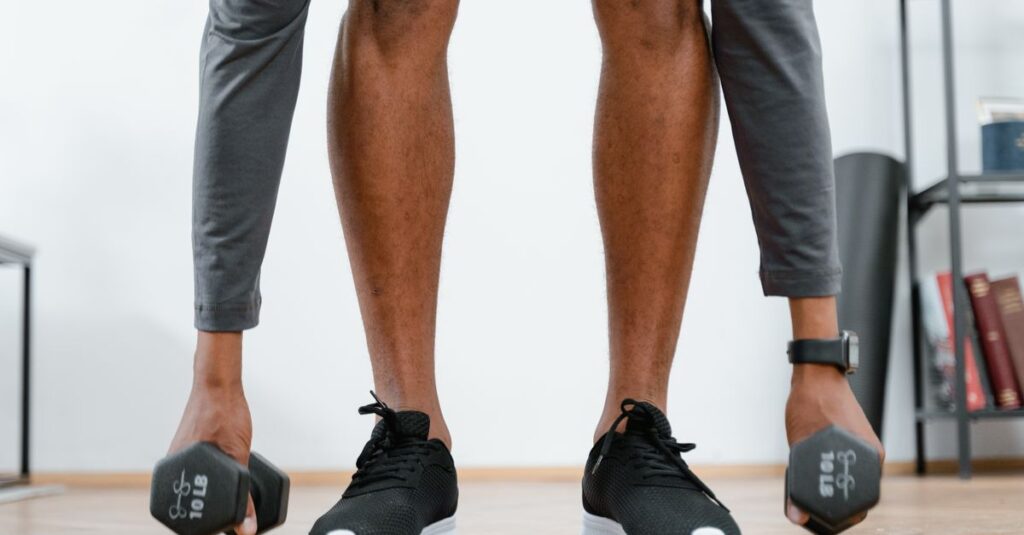

Dumbbell Exercises: A Practical Guide to Full-Body Strength
Estimated Reading Time: 5 minutes
Key Takeaways:
- Full-Body Coverage: Dumbbell training can target all major muscle groups through five basic movement patterns: squatting, hinging, pushing, pulling, and carrying.
- Minimal Starting Threshold: Performing just one set of 8 to 12 challenging repetitions twice weekly can produce measurable strength improvements for beginners.
- Safe Progression: The safest route to long-term progress is to “start low and go slow,” increasing repetitions before adding heavier weight.
- Balanced Fitness: Resistance training should be paired with at least 150 minutes of weekly moderate-intensity aerobic exercise for complete physical health.
Table of Contents
If you have a set of weights and need a simple, balanced routine, you do not have to master dozens of complex movements. Dumbbell exercises can strengthen every major muscle group in the body using five fundamental movement patterns: squatting, hinging, pushing, pulling, and carrying.
According to the Centers for Disease Control and Prevention (CDC) Physical Activity Guidelines, adults should perform muscle-strengthening activities that involve all major muscle groups—the legs, hips, back, chest, abdomen, shoulders, and arms—on at least two days each week. A compact pair of dumbbells is one of the most accessible tools to meet that standard, whether you work out in a home gym or a crowded fitness facility.
What Makes a Dumbbell Workout Effective?
Lifting weights builds strength only if the stimulus forces your body to adapt. The CDC guidelines on what counts as muscle-strengthening activity outline two key conditions:
- You must work all the major muscle groups: Legs, hips, back, chest, abdomen, shoulders, and arms.
- The effort must challenge your muscles: By the end of a set, doing another repetition should feel difficult without losing control or breaking proper form.
Federal public health guidance emphasizes that training does not require hours of daily lifting. Research summarized in the Physical Activity Guidelines for Americans (2nd edition) indicates that performing just one set of 8 to 12 repetitions can produce noticeable strength improvements for beginners. Performing two or three sets may offer additional benefits as your body adapts, but a single well-executed set provides a solid starting point.
6 Fundamental Dumbbell Exercises
To build a balanced routine, you need exercises that complement one another rather than repeatedly stressing the same joint angles. The six movements below target your entire body without requiring specialized benches or machines.
1. The Goblet Squat
- Primary muscles worked: Quadriceps, glutes, calves, and core.
- Why it works: Holding a single dumbbell vertically against your sternum acts as a natural counterweight, helping you keep your torso upright and your balance centered over your midfoot.
- How to do it: Stand with your feet slightly wider than hip-width, toes turned out slightly. Cup the top end of a dumbbell with both hands against your chest. Brace your midsection, bend your knees and hips simultaneously, and sit down between your thighs. Lower yourself only as far as you can while keeping your heels flat and your back straight. Push the floor away to stand back up.
- Easier regression: If balancing with weight feels awkward or causes knee discomfort, place a sturdy dining chair behind you and perform bodyweight box squats, sitting down lightly and standing up without holding a dumbbell.
2. The Dumbbell Romanian Deadlift (RDL)
- Primary muscles worked: Hamstrings, glutes, and lower back.
- Why it works: Unlike a traditional floor deadlift, the Romanian deadlift starts from a standing position and emphasizes the hip hinge. This stretches and strengthens the posterior chain, which helps counteract the effects of long periods of sitting.
- How to do it: Stand tall with a dumbbell in each hand, resting against the front of your thighs. Soften your knees slightly, then push your hips backward as if trying to tap a wall behind you with your tailbone. Keep the weights sliding close along your shins, and maintain a flat, neutral spine. Stop once your hips stop moving backward—typically just below knee height—and squeeze your glutes to drive the hips forward back to the starting position.
- Easier regression: Practice an unweighted hip hinge by standing six inches in front of a wall and reaching your hips back until your glutes touch it, keeping your hands on your hips.
3. The One-Arm Dumbbell Row
- Primary muscles worked: Latissimus dorsi, rhomboids, rear shoulders, and biceps.
- Why it works: Horizontal pulling balances out the pressing work that dominates many training plans. Supporting your non-working side on a bench or sturdy chair reduces strain on your lower back.
- How to do it: Place your left knee and left hand on a sturdy bench or chair, keeping your torso roughly parallel to the floor. Hold a dumbbell in your right hand with your arm extended downward. Without twisting your shoulders or hips, pull your elbow toward your hip, keeping your arm reasonably close to your ribs. Pause for a second at the top, then lower the weight with control. Complete your repetitions, then switch sides.
- Easier regression: If supporting your knee feels uncomfortable, place both feet flat on the floor in a staggered stance, rest one hand on a table or high surface, and row a lighter weight.
4. The Dumbbell Floor Press
- Primary muscles worked: Chest (pectoralis major), triceps, and anterior shoulders.
- Why it works: Performing a chest press while lying flat on the floor provides a natural stopping point for your elbows. This prevents over-stretching the front of your shoulder capsules, making it a joint-friendly alternative to a standard barbell bench press.
- How to do it: Lie on your back on an exercise mat with your knees bent and feet flat on the floor. Hold a dumbbell in each hand at chest level, with your elbows resting on the floor at roughly a 45-degree angle to your body. Press the dumbbells straight up toward the ceiling until your arms are fully extended but not aggressively locked. Slowly lower the weights until your triceps gently touch the mat, pause briefly, and repeat.
- Easier regression: If lowering or getting up from the floor is difficult, perform hands-elevated push-ups against a sturdy kitchen counter or a wall.
5. The Overhead Press (Seated or Standing)
- Primary muscles worked: Deltoids, triceps, and upper chest.
- Why it works: Vertical pressing builds shoulder stability and functional pushing strength. Performing this exercise seated provides back support, while standing requires more trunk stabilization.
- How to do it: Hold a pair of dumbbells at shoulder height with your palms facing forward or slightly turned inward toward each other (a neutral grip, which is often easier on sensitive shoulders). Brace your abdominal muscles and press the weights upward in a smooth arc until your arms are extended overhead. Lower them under control back to ear level.
- Easier regression: Perform the movement seated in a straight-backed chair with light dumbbells, or press one arm at a time to reduce the overall demand on your core.
6. The Farmer Carry
- Primary muscles worked: Forearms (grip strength), trapezius, core, and hips.
- Why it works: Carrying weights builds posture and functional stamina. It forces your abdominal wall and hip stabilizers to work together to keep you upright while moving.
- How to do it: Pick up a moderately heavy dumbbell in each hand. Stand tall with your chest up and shoulders pulled slightly back and down. Walk forward with smooth, controlled steps, avoiding letting the weights swing or knock against your legs.
- Easier regression: If floor space is limited, march in place for 30 to 45 seconds, or carry a single dumbbell on one side (a suitcase carry) to challenge your lateral core stability.
A Starter Full-Body Dumbbell Routine
Public health guidelines suggest training all major muscle groups at least twice a week. You can achieve this with a simple full-body circuit performed on two nonconsecutive days (such as Tuesday and Friday).
| Exercise | Target Area | Beginner Volume | Rest Interval |
|---|---|---|---|
| Goblet Squat | Quads, Glutes | 1–2 sets × 8–12 reps | 60–90 seconds |
| Dumbbell Romanian Deadlift | Hamstrings, Hips | 1–2 sets × 8–12 reps | 60–90 seconds |
| One-Arm Dumbbell Row | Upper Back, Lats | 1–2 sets × 8–12 reps/side | 60 seconds |
| Dumbbell Floor Press | Chest, Triceps | 1–2 sets × 8–12 reps | 60–90 seconds |
| Overhead Press | Shoulders, Arms | 1–2 sets × 8–12 reps | 60–90 seconds |
| Farmer Carry | Grip, Core, Total Body | 1–2 walks × 30–45 seconds | 60 seconds |
Understanding Rest Periods
General federal guidelines do not mandate a single universal rest period between sets. For general health and beginner adaptations, resting 60 to 90 seconds allows your heart rate to settle and your working muscles to clear metabolic waste products so you can perform the next set safely.
However, exact rest needs vary depending on your specific training goals. As highlighted in the American College of Sports Medicine (ACSM) Position Stand on Resistance Training, training variables change based on experience and intent:
- Muscular endurance routines often utilize lighter loads paired with shorter rest periods (under one minute).
- Hypertrophy (muscle growth) typically pairs moderate loads with moderate rest intervals (one to two minutes).
- Maximal strength and power development requires heavier loads and significantly longer rest periods (two to three minutes or more) to allow full nervous system recovery.
Beginners do not need to overcomplicate rest intervals. Take enough time between sets to feel stable, focused, and capable of maintaining proper form on the next set.
How to Progress Safely: Start Low and Go Slow
A core principle found across the Physical Activity Guidelines for Americans is to “start low and go slow.” When beginning a routine, choose a weight that feels manageable. Your initial goal is simply to learn the movement patterns without causing severe muscle soreness or compromising your joint mechanics.
Once you establish a consistent baseline, you can apply progressive overload:
- Earn your repetitions first: Select a weight you can handle for 8 clean repetitions. Stay with that weight over subsequent workouts until you can perform 12 repetitions with sound technique.
- Increase the resistance modestly: When 12 repetitions feel comfortable, increase the weight slightly (for example, moving from 10-pound dumbbells to 12- or 15-pound dumbbells).
- Drop back down the repetition range: With the heavier weight, drop your volume back to 8 repetitions per set, and repeat the process.
This steady method prevents sudden spikes in tendon and joint stress while giving your muscular system a consistent reason to adapt.
Limitations of Dumbbells (and How to Adapt)
While dumbbells are versatile, they have distinct practical limitations you should anticipate:
- Fixed increments: Standard dumbbell pairs jump by 2.5 or 5 pounds. Adding 5 pounds to a heavy squat is a small percentage increase, but adding 5 pounds to an overhead shoulder press represents a massive leap that can stall progress or cause form breakdown.
- Mismatched strength requirements: A weight that challenges your back during rows will usually be far too heavy for overhead pressing, while a weight appropriate for your shoulders will be too light to stimulate your legs. If you only have access to a single, light pair of dumbbells, you will need to rely on higher repetition ranges or slower lifting tempos to challenge larger muscle groups.
- They are not mandatory: Federal guidance makes it clear that dumbbells are only one way to build strength. Resistance bands, weight machines, suspension trainers, and bodyweight movements all stimulate muscle adaptation. Use what is available and comfortable for your body.
Remember Aerobic Activity
Strength training is only half of the physical activity equation. Federal recommendations advise combining your twice-weekly strengthening sessions with at least 150 minutes of moderate-intensity aerobic physical activity (such as brisk walking, cycling, or swimming) per week, as outlined in the CDC physical activity guidelines. Strength workouts do not replace the cardiovascular and metabolic benefits of aerobic work; they complement each other.
Safety, Risks, and Medical Considerations
Physical activity is safe and beneficial for the vast majority of people, but lifting free weights does introduce risks if approached carelessly. The CDC guidance on adding physical activity emphasizes that you can reduce injury risk by choosing activities suited to your current fitness level and using appropriate equipment.
Keep these practical safety habits in mind:
- Clear your floor: Tripping over a loose weight is one of the most common home-gym accidents. Keep your immediate training space free of clutter.
- Control every inch of the lift: Do not swing weights to generate momentum. If you cannot lift a dumbbell without contorting your torso, the weight is too heavy.
- Pick up and set down weights with care: Many injuries occur before or after a set. Use your legs—not a rounded lower back—when picking weights up from the floor or placing them down.
- Distinguish fatigue from pain: Muscular fatigue and a mild burning sensation in the working muscles are normal. Sharp, shooting joint pain or sudden pinching sensations are not. If an exercise causes joint pain, stop immediately.
When to Seek Professional Guidance
According to the CDC physical activity guidance for adults, individuals living with chronic medical conditions—such as heart disease, arthritis, or diabetes—should speak with a healthcare provider before significantly altering their exercise habits. A doctor or physical therapist can help you select safe movements and establish appropriate intensity boundaries.
Additionally, if you have been sedentary for a prolonged period, have a physical disability, or are carrying significant excess weight, consulting a professional before attempting vigorous training ensures you begin safely and progress comfortably.
Your Next Step
Do not worry about buying an entire rack of weights right away. Identify an open space in your home, choose one or two exercises from the list above, and test the movements using household items or a single light pair of dumbbells. Focus on moving smoothly through a comfortable range of motion, and build your routine one session at a time.
Frequently Asked Questions
How many days a week should I lift dumbbells?
According to public health guidelines, adults should perform muscle-strengthening activities involving all major muscle groups on at least two days each week.
Is doing just one set per exercise enough to build strength?
Yes. Research summarized in federal guidelines indicates that performing just one set of 8 to 12 repetitions can produce noticeable strength improvements for beginners, though two or three sets may offer additional benefits as your body adapts.
How long should I rest between dumbbell sets?
For general health and beginner adaptations, resting 60 to 90 seconds allows your heart rate to settle and muscles to clear metabolic waste products. Rest intervals can range from under a minute for muscular endurance to two to three minutes or more for maximal strength.
Does lifting weights replace the need for cardio?
No. Strength workouts do not replace the cardiovascular and metabolic benefits of aerobic work. Guidelines advise pairing twice-weekly strengthening sessions with at least 150 minutes of moderate-intensity aerobic physical activity per week.