
Bodyweight Exercises: A Practical Guide to Building Strength Without Equipment
Estimated reading time: 8 minutes
Key Takeaways
- Mechanical tension drives strength: Bodyweight training builds muscle primarily through altering leverage, changing angles, and adjusting tempo rather than adding external loads.
- Train movement patterns over muscles: A comprehensive program balances five essential patterns: squat, hinge/bridge, push, pull, and core stability to prevent postural imbalances.
- Systematic progressive overload: Difficulty can be steadily elevated without weights by changing lever arms, increasing range of motion, adding pauses, or raising repetitions.
- Public health alignment: Performing full-body resistance routines 2–3 days per week directly meets international health guidelines for muscular fitness and long-term joint health.
Table of Contents
- Introduction to Bodyweight Training
- How Bodyweight Training Builds Strength
- The Five Fundamental Movement Patterns
- How to Progress When You Cannot Add Weight
- Designing a Weekly Bodyweight Routine
- Special Considerations Across Age Groups
- Common Mistakes to Avoid
- Safety, Risks, and When to Seek Guidance
- How to Get Started Today
- Frequently Asked Questions
Introduction to Bodyweight Training
Bodyweight exercises use your own mass as resistance against gravity. They can build muscular strength, improve joint stability, and form the foundation of a lifelong fitness routine. You do not need specialized gym machines or free weights to get an effective workout, but you do need an understanding of how to make movements challenging enough to stimulate physical adaptation.
A common misconception is that bodyweight training is strictly for muscular endurance or high-repetition conditioning. In reality, “bodyweight” describes the source of resistance, not how difficult an exercise is. Changing your body angle, adjusting your leverage, or altering the speed of a movement can transform a basic exercise into an intense strength challenge.
The World Health Organization (WHO) physical activity guidelines recommend that adults perform muscle-strengthening activities at a moderate or greater intensity involving all major muscle groups on at least two days each week. Bodyweight training easily fits this criterion—provided the exercises demand genuine muscular effort and target the entire body rather than just a few visible areas.
How Bodyweight Training Builds Strength
Muscles grow stronger when they are subjected to mechanical tension that forces them to adapt. With traditional resistance training, you increase tension by adding weight plates to a bar. In bodyweight training, you increase tension primarily by altering geometry and manipulating leverage.
Consider the standard push-up. When you perform a push-up with your hands placed on an elevated kitchen counter, your feet support most of your body weight, making the load on your chest and arms relatively light. Place your hands flat on the floor, and you suddenly must press approximately 60 to 70 percent of your body mass. Elevate your feet on a bench with your hands on the floor, and the percentage of weight shifted onto your upper body increases further.
According to the American College of Sports Medicine (ACSM) position stand on progression models in resistance training, systematic progression requires manipulating training variables:
- Changing resistance or leverage
- Increasing repetitions or sets
- Altering movement tempo
- Modifying rest intervals
While the ACSM’s specific percentage-based load recommendations are designed around conventional free weights and machines, the underlying principle of progressive overload applies directly to bodyweight training. If an exercise variation is so easy that you can complete 30 effortless repetitions, it builds local muscular endurance rather than maximal strength. To prioritize strength, you must choose variations that feel challenging within a lower or moderate repetition range.
The Five Fundamental Movement Patterns
A balanced bodyweight program trains movement patterns rather than isolated muscles. By selecting one exercise from each pattern below, you ensure that every major muscle group is worked while avoiding the structural imbalances that develop from doing endless push-ups without back work.
       ┌────────────────────────┐
       │ Core Movement Patterns │
       └───────────┬────────────┘
    ┌──────────────┼──────────────┬──────────────┬──────────────┐
    ▼              ▼              ▼              ▼              ▼
Squat / Lunge    Hinge / Bridge   Upper Push     Upper Pull     Trunk / Core
(Quads, Hips)    (Glutes, Hams)   (Chest, Arms)  (Back, Biceps) (Abs, Obliques)
1. The Lower-Body Squat
Squatting trains the quadriceps, glutes, and calves while demanding mobility through the ankles and hips.
- Easier variation (Box or Chair Squat): Stand in front of a sturdy chair with feet shoulder-width apart. Hinge at your hips and bend your knees to sit down under control. Lightly touch the seat without relaxing your core, then push through your midfoot and heels to stand back up.
- Standard variation (Bodyweight Squat): Descend until your thighs are at least parallel to the floor, ensuring your knees track in line with your middle toes and your chest remains upright.
- Harder variation (Pause Squats or Skater Squats): Pause for two to three seconds at the bottom of each repetition to eliminate momentum, or progress toward single-leg squat variations that double the load on the working leg.
2. The Hip Hinge and Bridge
The posterior chain—the hamstrings, gluteus maximus, and spinal erectors—is responsible for hip extension and back health.
- Standard variation (Glute Bridge): Lie on your back with your knees bent and feet flat on the floor, hip-width apart. Drive through your heels to raise your hips until your thighs and torso form a straight line. Squeeze your glutes firmly at the top for one second before lowering under control.
- Harder variation (Single-Leg Glute Bridge): Extend one leg into the air while performing the bridge using only the opposite leg. This exposes side-to-side strength discrepancies and demands significantly more work from the working hamstring and glute.
3. The Upper-Body Push
Pushing patterns train the pectoral muscles, anterior deltoids, and triceps.
- Easier variation (Incline Push-Up): Place your hands slightly wider than shoulder-width on a sturdy table, wall, or elevated bench. Keep your body in a rigid straight line from your head to your heels, lower your chest until it lightly touches the surface, and press away.
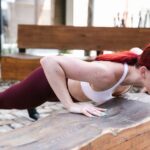
- Standard variation (Floor Push-Up): Perform the movement on the floor. Avoid allowing your lower back to sag or your elbows to flare out at a 90-degree angle; keep your elbows tucked at roughly 45 degrees relative to your torso.
- Harder variation (Deficit or Decline Push-Up): Elevate your feet on a low step to shift more load onto the upper chest and shoulders, or place your hands on books or low handles to increase the range of motion below your hands.
4. The Upper-Body Pull
Pulling exercises target the latissimus dorsi, rhomboids, trapezius, rear shoulders, and biceps. This is the hardest movement pattern to execute without any equipment, as gravity pulls you downward and pulling demands something to pull against.
- Easier variation (Doorframe or Inverted Table Row): Stand in a doorway, grip the frame firmly with your fingers, lean back slightly, and pull your chest toward the frame. For a more demanding horizontal pull, hang beneath a sturdy dining table, gripping the edge while your heels rest on the floor, and pull your chest toward the underside of the table.
- Standard variation (Suspension or Low-Bar Row): Using a low bar, suspension trainer, or gymnastics rings, hang with your body at a 45-degree angle to the floor and pull your chest up to your hands, squeezing your shoulder blades together.
- Advanced variation (Pull-Up or Chin-Up): Using a dedicated doorway pull-up bar or park equipment, hang from an overhead bar and pull yourself up until your chin clears the bar.
Note: If you cannot access a safe horizontal bar or anchor point, bodyweight pulling is difficult to load heavily. In that scenario, prioritizing a secure doorway bar or basic suspension trainer is often the best investment you can make for complete muscular balance.
5. Trunk and Core Stability
The core functions primarily to resist unwanted movement and transfer force between the upper and lower body, rather than simply flexing the spine through crunches.
- Anti-Extension (Plank): Rest on your forearms and toes, bracing your abdominal muscles as if anticipating a blow to the stomach. Keep your glutes squeezed and your pelvis in a neutral position to prevent your lumbar spine from arching downward.
- Coordinated Stability (Dead Bug): Lie on your back with your arms pointing toward the ceiling and knees bent at 90 degrees. Slowly lower your right arm overhead while extending your left leg straight out, keeping your lower back pressed firmly into the floor. Return to center and alternate sides.
How to Progress When You Cannot Add Weight
Because you cannot simply add a five-pound plate to your body, progress requires intentional adjustments to your form and mechanics. Use these methods to increase difficulty systematically:
| Progression Method | How It Works | Practical Example |
|---|---|---|
| Change the Lever Arm | Shifting where your body pivots changes the percentage of weight you lift. | Moving from knee push-ups to full push-ups, or from standard squats to single-leg squats. |
| Alter the Tempo | Slowing down the lowering phase increases time under tension without extra load. | Lowering yourself over 3 full seconds during a squat before standing up at normal speed. |
| Increase Range of Motion | Moving a joint through a deeper path forces muscles to work at longer lengths. | Placing your front foot on a 2-inch platform during split squats to sink deeper. |
| Add Pauses | Halting movement at the hardest point removes momentum and elastic recoil. | Holding the bottom of a push-up one inch off the floor for a full 2-second count. |
| Add Repetitions or Sets | Increasing total completed work challenges muscular endurance and capacity. | Progressing from 3 sets of 8 reps to 3 sets of 12 reps with identical technique. |
When adjusting variables, change only one factor at a time. If you decide to slow your push-up tempo to a three-second descent, keep your set count and hand position the same. Modifying multiple variables simultaneously makes it impossible to know which adjustment caused your performance to improve or stall.
Designing a Weekly Bodyweight Routine
For most healthy adults, a full-body routine performed two to three nonconsecutive days per week is ideal. This frequency satisfies the WHO physical activity recommendations for strength training while allowing 48 hours between workouts for recovery.
Strength training does not replace the WHO’s aerobic exercise recommendations—adults still need 150 to 300 minutes of moderate-intensity aerobic activity, or 75 to 150 minutes of vigorous activity, each week. Pair your bodyweight sessions with walking, cycling, running, or swimming to cover cardiovascular fitness.
A Practical Full-Body Framework
Perform each exercise with controlled technique. Do not train to absolute physical failure—the point where you collapse or cannot finish a rep. Instead, end each set when you feel you could only complete one or two more clean repetitions before your form breaks down.
Warm-Up (5–8 minutes):
  Arm circles, cat-cow stretches, gentle hip rotations,
  and 10 easy bodyweight squats.

Workout Circuit / Straight Sets:
  1. Knee or Incline Push-Ups: 2–3 sets of 8–12 reps
  2. Bodyweight Box Squats: 2–3 sets of 10–15 reps
  3. Inverted Table Rows or Doorframe Rows: 2–3 sets of 8–12 reps
  4. Glute Bridges: 2–3 sets of 12–15 reps
  5. Front Plank: 2–3 sets of 20–30-second holds

Rest: 60 to 90 seconds between sets to allow muscle recovery.
Understanding Rest Intervals
The ACSM position stand notes that the length of rest periods dictates metabolic recovery between sets. Heavy strength training typically benefits from longer rest periods (two to three minutes) to allow near-total neuromuscular recovery, while endurance training relies on shorter windows.
There is no single mandatory rest period for bodyweight exercises. Rest long enough that you can perform your next set with sound technique, without feeling so fatigued that your posture collapses halfway through. For most bodyweight circuits, 60 to 90 seconds between exercises works well.
Special Considerations Across Age Groups
Bodyweight exercise is adaptable, but physical needs vary significantly across the lifespan.
For older adults, the WHO guidelines emphasize multicomponent physical activity that incorporates both functional balance and strength training on three or more days per week. This specific emphasis helps enhance functional capacity, preserve independence, and lower the risk of falls.
Older Adult Multicomponent Focus:
  ┌────────────────────────────────────────────────────────┐
  │ Functional Leg Strength (e.g., Chair-assisted squats)  │
  │ Lateral Hip Stability   (e.g., Side-lying leg raises)  │
  │ Static/Dynamic Balance  (e.g., Tandem stance, marches) │
  └────────────────────────────────────────────────────────┘
An older adult might replace free-standing squats with sit-to-stand repetitions from an armchair, use wall push-ups to spare wrist and shoulder joints, and include single-leg balancing drills next to a sturdy counter.
Common Mistakes to Avoid
- Sacrificing range of motion for repetitions. Doing twenty partial push-ups where your elbows barely bend does not build meaningful strength through the chest and triceps. Perform eight full-range repetitions instead, where your chest comes close to the floor and your arms lock out smoothly at the top.
- Ignoring the posterior chain. It is easy to drop to the floor and push, which is why many home routines end up heavily biased toward the chest, shoulders, and quads. If you push, you must pull. Balance your routine with rows, bridges, and back extensions to protect shoulder mechanics and spinal posture.
- Letting the core collapse. During push-ups, planks, and lunges, a sagging lower back places unnecessary stress on the lumbar spine. If your hips droop toward the floor during a push-up, elevate your hands to an incline to restore a straight, braced spine.
- Treating soreness as the primary metric of success. Delayed-onset muscle soreness (DOMS) simply means your body encountered an unfamiliar movement pattern. It does not indicate how effective a workout was. Track your progress by improvements in control, repetitions, and difficulty, not by how sore you feel the next day.
Safety, Risks, and When to Seek Guidance
Bodyweight training is not inherently safer than using gym equipment. Tendons, ligaments, and joints can still be strained if you use jerky momentum, jump into advanced progressions prematurely, or train through pain.
- Joint pain vs. muscular fatigue: A burning sensation in the middle of a muscle belly is normal fatigue. Sharp, pinching, or stabbing sensations inside a joint—such as the front of the knee or the top of the shoulder—are warning signs to stop immediately and adjust your angle or regression.
- Secure your anchor points: If you use a table for rows or a doorway bar for pull-ups, verify that the structure is completely stable and able to bear your weight before hanging from it.
- Medical clearance: If you have preexisting cardiovascular conditions, musculoskeletal injuries, are pregnant, or have been completely sedentary for an extended period, speak with a qualified healthcare professional or physical therapist before starting. They can provide individual modifications that match your medical history.
How to Get Started Today
Do not worry about complex exercise variations right away. Pick one variation for each of the five foundational movement patterns—squat, hinge, push, pull, and core—that you can execute comfortably for 8 to 10 repetitions without joint pain.
Perform two sets of each movement twice this week, resting about a minute between sets. Keep a simple notebook or note on your phone recording what variation you performed and how many repetitions you completed. Once those repetitions feel steady and predictable, use the progression methods above to challenge yourself further.
Frequently Asked Questions
Can you build real muscle and maximal strength using only bodyweight exercises?
Yes. Muscles respond to mechanical tension, not the specific tool creating the resistance. By altering leverage, manipulating tempos, and moving toward challenging single-limb variations (such as pistol squats or deficit push-ups), you can place substantial tension on muscle fibers to stimulate hypertrophy and strength gains.
How do you train the back muscles without any gym equipment?
Pulling movements are the most challenging to replicate without gear, but you can perform horizontal rows by leaning back while gripping a sturdy doorframe or lying under a solid dining table and pulling your chest toward the underside of the tabletop. For optimal results, investing in a basic doorway pull-up bar or suspension trainer is highly recommended.
How often should I perform bodyweight workouts each week?
A schedule of two to three nonconsecutive days per week is ideal for most individuals. This aligns with public health guidelines and allows 48 hours of rest between sessions for muscle repair and recovery.
What should I do if an exercise causes joint pain?
Never train through sharp, pinching, or stabbing joint pain. Regress the movement immediately to an easier angle (e.g., switching from floor push-ups to incline push-ups on a wall or counter) to reduce joint stress, or consult a physical therapist if the pain persists.